
Aerospace engineers recreate the moon’s difficult terrain to help next-gen space robots work together, explore, and build on the lunar surface.

Professor Yashwanth Nakka in the Aerospace Robotics Lab. (Photo: Cameron Eure)
Traveling to the moon for scientific discovery is expensive. And even once you get there, operating a rover on the moon is nothing like driving on Earth — the uneven terrain, deep shadows, and unpredictable soil make autonomy essential.
So, what do you do if you want to design robots and their controlling algorithms for future moon visits? If you’re Yashwanth Nakka, you bring the moon to you.
Nakka has recreated the moon in a research lab at Georgia Tech, hauling in seven tons of basalt rock to mimic the look and feel of the lunar surface. With dark black walls and a bright light that simulates the sun’s glare, the Aerospace Robotics Lab (ARL) is the only one of its kind in a university setting.
This lab will help Nakka’s team of researchers understand how robotic rovers interact with the environment on the moon — how they perceive the terrain in different sunlight conditions, for example, and how they navigate across a surface that can easily swallow a rover wheel.
“From a research perspective, many of today’s space mobility solutions still build upon algorithms developed two decades ago. This new lab positions us to pioneer the next generation of autonomous mobility technologies that can overcome unstructured terrain, environmental, and operational challenges. Advancing autonomous systems is critical to enabling deep-space exploration, supporting resource utilization, and empowering scientists to investigate new frontiers such as icy moons that may harbor subsurface oceans,” said Nakka, assistant professor in the Daniel Guggenheim School of Aerospace Engineering.
Unlike the Moon’s ultra-fine, clingy regolith that can coat equipment and cause severe wear and damage, Nakka’s lab uses carefully selected, gem-sized basalt rocks. This material allows researchers to realistically study how robots interact with granular terrain while avoiding the need for extensive protective equipment, making experimentation safer, more efficient, and easier to conduct. When robots are driving on the surface, they experience the same shifts and movements they would in the moondust.
(text and background only visible when logged in)
Algorithms that Help Rovers Think and Decide on Their Wheels
The lab uses specialized lights that mimic the sun because lighting conditions can significantly impact rover operations. A typical rover relies on cameras to identify objects — such as determining whether something is a rock and whether the rover should drive around or over it.
The rover also must assess slopes and evaluate whether the terrain is stable enough to traverse. These decisions are usually made with a human in the loop; Nakka is developing control systems that would allow the rovers to operate without that human intervention.
“Lighting conditions make this process challenging,” Nakka said. “For instance, direct sunlight on the camera can distort what the rover sees. One of the greatest obstacles is developing algorithms that remain robust and reliable despite these varying environmental factors.”
The team’s algorithms will empower vehicles to independently assess their surroundings, identify safe paths, and select scientifically intriguing targets, all on their own. They also will allow the rovers to work together to explore or achieve other objectives.
"Developing effective algorithms requires more than simply studying a standard vehicle and attempting to adapt autonomy solutions from there. That approach limits performance, particularly when driving at high speeds,” Nakka said. “To achieve truly dynamic and responsive autonomous control, our algorithms must understand how the vehicle interacts with the terrain, control for uncertainty, and incorporate that surface to wheel contact information in real time.”
(text and background only visible when logged in)

Professor Nakka working on rovers for testing. (Photo: Cameron Eure)
Next-Gen Robots for the Moon’s Hidden Extremes
Alongside control algorithms, Nakka and his team are crafting new robots capable of exploring harsh moon terrain and accessing challenging environments, such as lunar vents and caves. These shape changing robots, inspired by Nakka’s previous work at NASA’s Jet Propulsion Laboratory (JPL), will cover territory that conventional rovers simply can’t reach.
"We aim to integrate robot design with algorithm development to create systems that are adaptive and capable of changing shape. For example, a rover that can crawl, lift a leg to clear debris when stuck, and continue moving—demonstrating the importance of built-in adaptability."
Nakka’s long-term vision for autonomy is to develop a rover capable of understanding both its environmental context and its own internal state. This includes recognizing available resources as well as interpreting external conditions. Achieving this level of autonomous self and environmental awareness is expected to take approximately a decade.
Ultimately, the work being done in the ARL will shape the next decade of space robotic exploration, making it possible for rovers to go farther, think faster, and survive in places no human or robot has ever gone.
Related Stories:
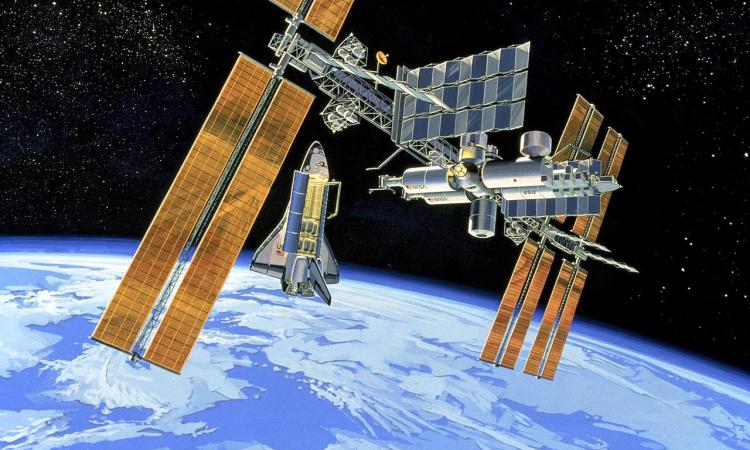
Joint Venture Marks a New Era in Aerospace and Policy Research
As space becomes more crowded, and more congested, engineers and policymakers are increasingly working together to realize a shared vision of a peaceful, prosperous final frontier. In response, Georgia Tech's Sam Nunn School of International Affairs (INTA) and Daniel Guggenheim School of Aerospace Engineering (AE) are partnering to create the Engineering Space Policy Laboratory (ESPL), an interdisciplinary collaboration drawing from Georgia Tech's strengths in the engineering and social sciences.
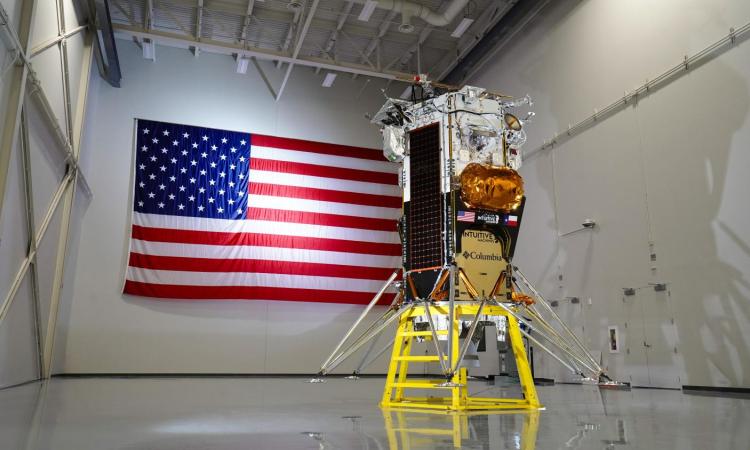
New Algorithms Developed at Georgia Tech are Lunar Bound
Georgia Tech’s Space Exploration and Analysis Laboratory (SEAL) has developed new algorithms that are headed to the Moon, as part of the Intuitive Machine’s IM-2 mission. The mission is sending a Nova-C class lunar lander named Athena to the Moon’s south pole region to test technologies and collect data that aim to enable future exploration. The mission is part of NASA’s Commercial Lunar Payload Services (CLPS) initiative.